

How To Clean Up Hard Drive On Mac
A full startup deejay is something that every Mac user will feel. This trouble used to exist known as "Startup disk full" notification. However, on newer macOS versions this bulletin has been changed to "Your disk is almost total."
But luckily, it's a problem that has many solutions. And in this article, we'll get over:
- What is startup disk total?
- What's causing "Your deejay is near total" alarm?
- How to prepare startup disk full?
- How to prevent "Your disk is well-nigh full" problem?
However, nosotros also understand that some people are brusk on time and just desire to fix startup disk total. And so, if you're non really interested in what it is and why it happens, but skip the adjacent two sections and caput to "How to Make clean Your Startup Disk".
Or, fifty-fifty better, if you're looking how to clear space on Mac, we'd highly recommend a utility called CleanMyMac 10. It'll assist you clean upward gigabytes of disk infinite in just minutes (you can download it here).
Note: if y'all're running a newer version of macOS, information technology has a built-in option of Optimized Storage that is supposed to solve the trouble of the full hard bulldoze by moving files into the cloud.
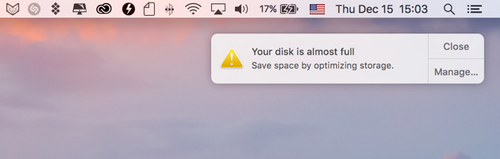
Past clicking "Manage" you can open up the menu and see what Optimized storage offers. Notwithstanding, it moves junk and useless files to the cloud together with your files, and eventually, y'all end up paying for iCloud storage to store junk. And so we still recommend getting CleanMyMac and really dealing with extra files rather than but moving them.

Now, with all that said, let's get into what exactly "Your deejay is nigh total" means.
Agreement What "Your Deejay is Near Full" Means
What is a startup disk?
A startup deejay, as taken from Apple tree Support article, is a volume or division of a drive that contains a usable operating system. Nevertheless confused? Let'southward break it down for you.
Your Mac hard bulldoze consists of disks (or partitions). Each deejay (or division) has your Mac data on it, which consists of your operating system, applications, etc. Well-nigh Mac users have just one disk just ability users may have two or more than.
Permit'southward look at an example of a Mac with only one hard disk:
- Your Mac's difficult drive is 500GB.
- Information technology has one "deejay" on it, so all 500GB of storage is on that disk.
- The disk has an operating organisation (macOS Monterey), and user data (apps, etc).
- And since you only have ane deejay, this is your startup disk: all 500GB.
A Mac with two disks will have the storage divided between them. The Mac bulldoze with the Os on it is the startup disk while the other drive is simply used for storage of files. It's possible to accept multiple startup disks, merely nearly Macs volition only accept one. And for proper deejay cleanup on Mac, all drives are just every bit important.
Why your deejay is nigh full?
This is easy. It's a lot like why is your fridge full? There is no more infinite! Your disk is near full and this is very bad news for any drive. A hd should never go beyond 85% capacity (especially a startup deejay) equally you lot will experience slowness and errors the further you get to a higher place that marker.
If your startup disk is full and you get a bulletin of alarm from your Mac, this is a serious indication that you demand to articulate up storageimmediately.
What to exercise when your deejay is almost full?
Then how do you fix your about total startup disk? The aforementioned manner you solve the trouble of a packed fridge - yous need to clear up storage, of course. To make more space on your startup disk you will need to:
- Delete files from your Mac.
- Move files to an external hard drive or cloud storage.
- Or install a 2nd internal hard bulldoze on your Mac.
Then, now that we know what a startup deejay is, nosotros need to talk about how to set information technology. Let's take a closer look at your disk space to see exactly what is causing your disk to be almost total.
What's Causing "Your Disk Is Virtually Full" Alert?
Brusk version: Take a look under-the-hood of your Mac.
Before we can run into what is taking upward infinite on your startup disk, outset we accept to observe it:
- Hover on the Dock at the bottom of your screen and open up Finder.
- Click on "Finder" in the menu bar at the meridian of your screen.
- Then select "Preferences…"
- In the window that opens, checkmark the "Difficult disks" checkbox.
Afterward selecting this box, your desktop should now show the difficult disks on your Mac, in the grade of icon(s), similar this:
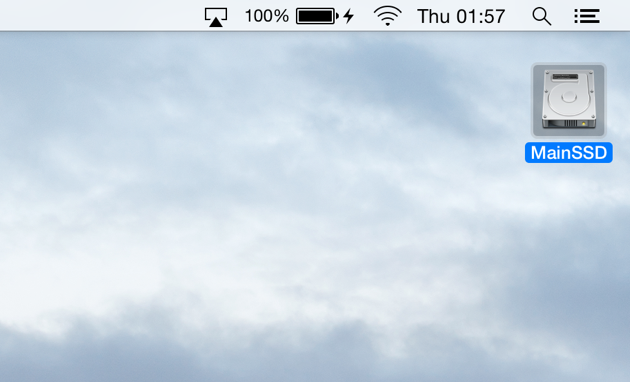
These are disks on your Mac that you can "startup", this is because they accept operating systems on them. If there is more than than one of these hard disk icons that show up on your desktop, it ways y'all've got multiple difficult disks on your Mac. If you only take one, skip the down to "What is taking upwards all of my startup deejay space?" section.
If you have more than one, go on with the next pace:
Click on the Apple icon at the summit left of your screen System Preferences > Startup Disk.
Here, once more, yous'll observe your hard deejay(s); they're probably named something similar MainSSD or MainHD. Information technology will too display "OS" and the version number of that OS. If you have more than 1 OS bulldoze, your startup disk should be the one with the latest version of macOS running on information technology, but we're going to make sure of that in the next footstep.
I only have one and information technology looks similar this:

To brand 100% sure that yous know what drive is your startup disk, follow these steps:
- Click on the Apple Icon in the carte at the meridian-left of your screen.
- Select "Near This Mac."
- Under macOS, you'll find a version number. Mine is 12.0.ane, similar so:

See how my version number in the "About This Mac" window matches the number in my Startup Disk section? Aye — That's my startup deejay. Found yours? Skillful.
What is taking upward all of my startup deejay infinite?
Now that we've identified our startup disk, allow's have a closer look at how to clear upward space on Mac:
- Click the Apple tree Icon in the menu at the top-left corner of your screen.
- Cull "About This Mac."
- Click Storage.
Notation: If y'all are running an older version of OS 10 you may have to first click "More Info…" and then "Storage".
Accept a look at my difficult drive disk:

I've got 250GB of storage, and about 168GB of it is gratis.
So, how large is your hard disk drive? How much free space do yous accept (if any — *gulp*)? And what's taking upwardly the most space? Information technology is important to consider bulldoze chapters and data storage needs for hereafter storage plans — we're not just here to ready the trouble, for now, nosotros're going to make sure yous never have this trouble in the hereafter also.
Now that we take the knowledge, it's time to have action and fix your Mac's "Startup Deejay Full" trouble.
How to clear deejay space on Mac
Let's go over 11 things you tin exercise to assist fix "your disk is almost full." These should also requite you lot other ideas every bit to how else to prepare information technology — Y'all know your Mac better than nosotros practise!
one. Clear system storage on Mac

Organisation storage cleanup sounds like a serious undertaking. Simply, technically, information technology boils down to just 1 thing: having the courage to fleck the old files.
- Search for large Cipher/RAR archives in Downloads.
- Open your Desktop (Control + F3) and delete screenshots.
- In Applications, sort your apps past size. Delete the largest ones.
- Restart your Mac to free upward RAM.
- Get rid of system junk files with a free version of CleanMyMac X.
This app gives y'all lots of possibilities to gratis up space, especially when information technology comes to arrangement junk. CleanMyMac X has been notarized by Apple, which basically means information technology's safety to use. And if you got 5 minutes, try this tool as it shows you where exactly your junk hides.

2. Clean upwards cache files on your Mac

Cache files are files that help your Mac run programs a bit more smoothly. Call up of them like blueprints for a house: your Mac has the blueprints for how a program is supposed to load/run/look, so it loads it faster; without them, it'd be similar building it from scratch. However, over fourth dimension, these caches tin can commencement to accept upwardly some serious infinite. Periodically, removing them tin can assistance clear storage. And don't worry, your Mac will create fresh, new ones after you restart your Mac. To remove caches:
- Open up a Finder window and select Go in the menu bar.
- Click on "Go to Folder…"
- Type in
~/Library/Caches
Delete the files/folders that are taking upwardly the most space. - At present click on "Go to Folder…"
- Blazon in
/Library/Caches(simply lose the ~ symbol)
And, again, delete the folders that have upward the most space.
Deleting cache files is generally safe for your Mac. And once you delete them, the applications and processes you run on your Mac will generate fresh, new ones. But, when deleting, worry more virtually removing them based on size rather than just removing all of them.
Besides, y'all can check the /System/Library/Caches folder as well, simply it might be better not to bear on this binder without knowing what the items are. A utility that correctly cleans up these files (and pretty much everything else on this listing) is, you guessed it, CleanMyMac X. Information technology cleans up fifty-fifty your system caches with but a few clicks.
Oh, and once you're done with this list, restart your Mac so it can create these new cache files.
Read more: How to Clear Enshroud on a Mac?
iii. Become rid of localization files

Localization files are also known as "linguistic communication packs." Lots of apps come up with other languages that you probably don't need. To clear up space on your Mac, delete the ones you don't need:
- Open a Finder window.
- Go to Applications.
- Ctrl+click on an application.
- Select "Bear witness Package Contents."
From hither, get to Contents > Resource and await for files catastrophe in .lproj. These are the languages your app has simply in example you want to use it in another language, like Castilian (es.lproj). Drag the ones y'all'll never utilize to the Trash.
Once more, a safer alternative to this would be to use CleanMyMac X. It gets rid of all of them with a click. No digging through application folders, merely a cleaner Mac.
Read more: How to Delete Linguistic communication Files from macOS?
4. Delete indistinguishable files

Fifty-fifty if you lot have the most organized Mac on a planet, duplicates happen one manner or another. It tin be a file yous've mistakenly downloaded twice or a mail attachment you've opened several times. Regardless of how they appeared, those files sit on your Mac and gobble upwards storage.
Simply finding and deleting them is a time-consuming procedure if you practise information technology one by one. So here'south what yous tin do for a simple Mac disk cleanup:
- Open the Finder app on your Mac
- Movement cursor over File and click New Smart Binder
- Click the "+" button in the upper right corner and cull the type of files you want to run into
- Now sort them by name to quickly spot duplicates.
Remember to pay attention to the date of creation to make sure you lot go on the truthful original, not the re-create.
While this is the all-time way to remove duplicates manually, it takes lots of your time and dedication. It'd be much easier to go out this to Gemini ii: The Duplicate Finder.

This app rapidly scans your Mac for duplicate and similar files and allows you to delete them within minutes. Information technology keeps your originals prophylactic and helps you easily retrieve files deleted by accident.
five. Remove old iOS backups
Backups tin can tend to take up a lot of space. You can find and remove them by:
- Launching a Finder window.
- Clicking "Go" in the carte du jour bar.
- Selecting "Go to Folder…"
- Then, type in
~/Library/Application Support/MobileSync/Backup/
Get rid of all the old, outdated backups your Mac has been storing for a bit more extra space.
6. Remove big and one-time files

Keeping many large files on your Desktop and in Documents slows down the system. And if yous delete just a couple of these enormously large files, yous can go half of your storage back.
Permit'southward open up the familiar About this Mac pane over again. If you click Manage, you'll see this window for sorting files.

While this instrument is expert for finding big files, it misses a lot of things. See that "Other" category that takes up 38.GB?
To deepen your search for massive files, utilize this tool from CleanMyMac X. It'south called Big & Former files finder.

It'due south much more than helpful equally it shows you lots of other categories of files, like Archives. The app breaks your files past Size and Last Used.
To see this instrument in action, download the free edition of CleanMyMac X. And click the Large & Former files at the bottom of the sidebar.
vii. Remove unnecessary applications

This isn't often overlooked, merely definitely under-appreciated. Removing onetime, unused applications is a great way to get some extra space on your startup deejay. Go through your applications folder and become rid of all the apps you rarely use. Only make sure yous remove them correctly, don't just drag them to the Trash. If y'all do, you'll exit behind tons of leftover parts and pieces, and nosotros're trying to go back startup disk infinite — Information technology'll kinda defeat the purpose, no?
This is another place nosotros'd advise using CleanMyMac 10. To completely remove any application, just launch CleanMyMac X, click Uninstaller, select your awarding, and so click Uninstall. You won't have to search all over for development junk that's left behind when Trash'ing an awarding. It'due south incredibly easy and saves you lot tons of time.
8. Motion your Photos and Docs to the deject

When your local storage is full to the brim, your Mac will start uploading this data to iCloud. But only if y'all have this setting enabled. Is your Photos app synced with iCloud already? Let's check.
- Open Applications and observe the Photos icon.
- Launch Photos and click on Preferences in the meridian menu.
Ticking the box iCloud Photos will connect your Photos library to iCloud. And what'southward more important, if you select Optimise Storage, some part of your Photo library volition exist moved to iCloud. This fashion you macOS saves precious space. The gratuitous iCloud program allows you to free upwardly at to the lowest degree v GB worth of storage.

The like logic applies to your Documents and other files. To prepare the cloud backup with iCloud bulldoze, become to System Preferences > Apple tree ID > iCloud.
9. Clean up your Downloads, Movies, and Music folders

Have a closer wait at these three folders. You'd be surprised at how many downloads can accumulate when you aren't paying attention. Clean out annihilation you lot don't need (or don't know) and organize the rest. Information technology'll take a load off your mind to know that at that place'due south nothing excess there.
The Movies folder can exist a pain, non because y'all're searching through tons of files, just it can be hard to choose what to delete. Personally, I never desire to get rid of Meridian Gun. It's astonishing. I watched it three times in a row last weekend. But alas, sometimes yous need to brand sacrifices for the wellness of your Mac. Though, what you can do with movies you want to go on is to archive them. So, archive what yous wish to keep and remove the rest.
How to archive/compress a file
Archiving a file doesn't mean to store deeper into the abyss of your Mac — only to turn the file into something smaller, into a compressed file (like .nil or .tar). Past archiving a file, you shave off some memory. Archiving is essential for things y'all want to keep on your Mac, only don't ofttimes use, and helps you articulate upwards some infinite. And that's what this is all about right? We're essentially doing the hokey-pokey on your Mac. To annal a file, simply:
- Control-click the file you want to compress (recommended for picture files).
- Select, "Shrink ."
The last identify to sweep through is the Music folder. Find and remove duplicate music files get-go, and then make clean up all the songs you downloaded on a weird Sunday afternoon cleaning the house.
10. Clean your Desktop
"Make clean my desktop… only why?" Because some people'due south desktops are hard to look at, that's why. Organize your desktop and become rid of the stuff you just don't demand on there. Information technology looks better and helps your Mac act a bit faster (I don't know the rocket science behind this one, but it feels too good to be false). Your Mac doesn't waste time loading all those icons and junk, just… Just clean information technology, please.
11. Empty out the Trash (No, we're not joking…)

Seriously: It may sound incredibly basic, but it could clear a surprising amount of storage. I forget to do information technology all the time. The thing is, that when you delete something, your Mac doesn't remove it — it just moves it to the Trash. Plus, y'all've probably deleted mode more than you lot realize, and all that could be sitting in the Trash, wasting space. So become rid of all that junk past emptying the Trash:
- Command-click your Trash in the Dock.
- Select "Empty Trash."
- And click "Empty Trash."
And, the easiest stride is done.

A few more tips to articulate storage on Mac
i. Manage your Optimized Storage
This choice comes with your operating system starting macOS Sierra. Go to the Apple bill of fare > Near this Mac > Storage
Now, click on Manage to reveal the space-saving options:

two. Erase your Junk Post
Open your Mail service app, and click Mailbox in the upper menu. Here y'all can erase spam and already deleted items.
Total Startup Disk Prevention
We've cleaned up a few things on your Mac, and hopefully, it'south given you more ideas as to what else you can clean. But, let'southward take a look at how much space you saved from cleaning the list above. Remember how we checked your Mac'due south complimentary infinite? Open that window again and see how much space you've cleared up:
- Click the Apple Icon in the menu at the top-left corner of your screen.
- Choose "About This Mac."
- Click Storage.
Note - If you are running an older version of macOS you lot may take to first click "More Info…" and and so "Storage".
Y'all've probably got a flake more space, and you'll want to keep it that way. The only way to foreclose a "your disk is almost full" is past keeping your Mac clean. We'd recommend a complete cleaning every 2–iii weeks.
Say bye to the "Your startup disk is almost full" message.
We've told y'all how to delete storage on Mac in multiple ways. Hopefully, this has helped y'all ready that full startup disk problem. Your startup disk should now be quite a scrap lighter (we promise). Oh, and if you liked this article, go social with it to help others in demand. And if y'all really liked this article, subscribe to our electronic mail listing — nosotros've got more guides on the style. And we've also got a utility that'll help you out a ton in the long run: CleanMyMac 10. It helps you clean your entire Mac with just the click of a button. It's incredibly easy to use and works similar a charm.

Source: https://macpaw.com/how-to/startup-disk-full-on-mac-os-x
Posted by: yohowatiod1959.blogspot.com
0 Response to "How To Clean Up Hard Drive On Mac"
Post a Comment